Category: News
Quantity of impervious surfaces such as buildings, roads, and parking lots, are often used as an indicator of the degree of urbanization and environmental quality in urban areas. Watersheds with high impervious surface coverage experience higher peak flows, decreased infiltration and recharge, and reduced baseflows in streams (Leopold, 1968). This causes streambeds to scour, resulting in loss and degradation of important ecological habitat in-stream and in riparian zones (Gillies, Brim Box, Symanzik, & Rodemaker, 2003).
However, the spatial distribution and connectivity of impervious surfaces as well as the characteristics of the area (e.g., soil conditions, slopes, precipitation patterns) also effect the quantity and quality of stormwater runoff (Jacobson, 2011). In effect, a landscape’s impervious area may be divided into two categories: those that drain to a pervious surface, and those that drain directly to the stormwater or stream network. Because of their direct contribution to storm flows, these directly connected impervious areas are reported to be a better indicator of hydrologic response, biologic integrity, stream alteration, and water quality than total impervious area. Despite this fact, few studies have developed simple and transferable methods for identifying these connected impervious areas. Better identification of impervious surfaces that contribute to stream degradation and alteration can then be directly linked to management actions, such as stormwater fees, tradable stormwater credits, or strategic stormwater management (Roy & Shuster, 2009).
This year, River Lab’s Anneliese Sytsma is working with ‘Reinventing The Nations Urban Water Infrastructure‘ (ReNUWIt) – an interdisciplinary, multi-institution engineering research center funded by NSF – to develop a simple and transferable methods of identifying these directly connected impervious areas and evaluate their role in reducing peak flows in urban areas. To do this, she is using combination of remote sensing, geospatial analysis in GIS, hydrologic analysis in ArcHydro, field survey, and stormwater modeling. She is testing her model in the Petaluma River Watershed, in Sonoma County, California.
Sources:
Gillies, R. R., Brim Box, J., Symanzik, J., & Rodemaker, E. J. (2003). Effects of urbanization on the aquatic fauna of the Line Creek watershed, Atlanta—a satellite perspective. Remote Sensing of Environment, 86(3), 411–422. https://doi.org/10.1016/S0034-4257(03)00082-8
Jacobson, C. R. (2011). Identification and quantification of the hydrological impacts of imperviousness in urban catchments: A review. Journal of Environmental Management, 92(6), 1438–1448. https://doi.org/10.1016/j.jenvman.2011.01.018
Leopold, L. B. (1968). Hydrology for urban land planning: A guidebook on the hydrologic effects of urban land use.
Roy, A. H., & Shuster, W. D. (2009). Assessing impervious surface connectivity and applications for watershed management. JAWRA Journal of the American Water Resources Association, 45(1), 198–209.
This recently published study by Pedro J. Pinto, Matt Kondolf, and Raymond Wong (Environmental Science and Policy 90: 28-37) explores examples where actual implementation of SLR adaptation has led, or may lead to, the need to revise standards and practices or require uneasy choices between conflicting public interests. While there is broad agreement in principle in the San Francisco Bay region on the need to adapt to sea-level rise through innovative approaches, actual implementation has proven difficult because of institutional complexity and communication challenges among stakeholders, including conflicting agency mandates and priorities. Removing institutional barriers to adaptation will almost certainly require some agencies to adapt their policies, but path dependence is an obstacle. The article is available for free download until 18 November here.
A related paper explores why the SF Bay is so highly vulnerable to sea-level rise by comparison to the Tagus Estuary, Lisbon, Portugal, which is physiographically similar but was subject to a very different development history. A key difference was the role of the US Swamp Act of 1850, which turned tidal lands over from the federal government to states so the latter could encourage drainage and development, leading ultimately to a vast area of urban settlement subject to inundation in coming decades. By contrast, in Portugal such tidal lands remained in the control of the crown, and were managed mostly for low-intensity agriculture, so today these lands are available to accommodate the landward migration of tidal wetlands with sea level rise, without conflicting with most urban land uses. The paper,
“Evolution of two urbanized estuaries: environmental change, legal framework, and implications for sea-level rise vulnerability” (Water 8:535) is available online (open access) at http://www.mdpi.com/2073-4441/8/11/535/pdf
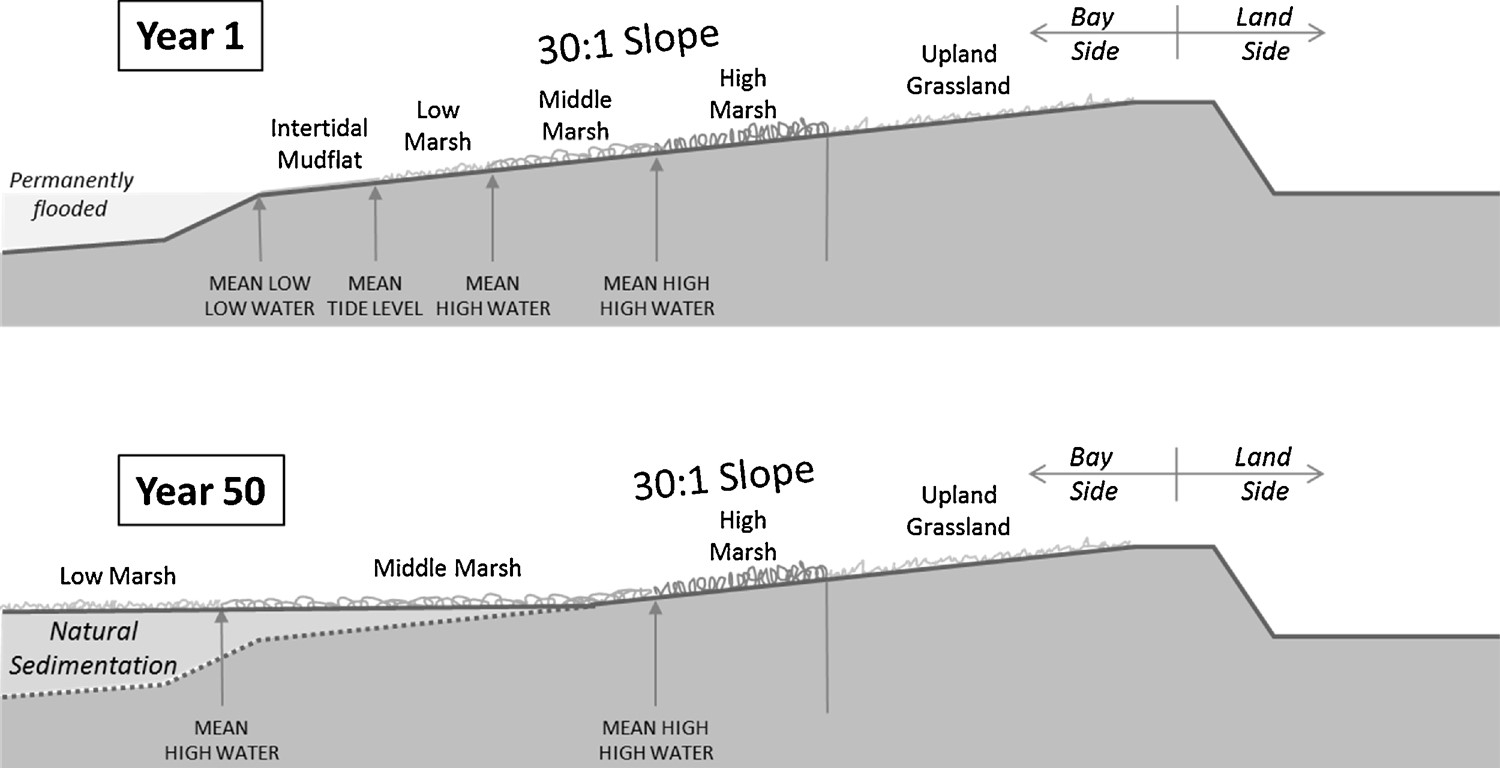
‘Horizontal levee’ with migrating ecotone. (adapted from HDR 2015)


Paradigms like “the right-project in the right place” have been proposed to make hydropower more sustainable by selecting low-impact / high-benefit dam sites. But what is a good strategy for selecting the right projects and places, and can such strategic hydropower planning really contribute to develop more sustainable hydropower? The February issue of Nature Sustainability “Strategic Planning for Dams” features the research of Rafael Schmitt and Matt Kondolf from UC Berkeley, together with Simone Bizzi and Andrea Castelletti from Politecnicno di Milano (“Improved trade-offs of hydropower and sand connectivity by strategic dam planning in the Mekong” DOI: 10.1038/s41893-018-0022-3). In that paper, we demonstrate that strategic selection of dam sites can greatly improve the trade-offs between hydropower production and dam sediment trapping, one of the key environmental impacts of dams.
The Se Kong, Se San, and Sre Pok form a major tributary basin of the lower Mekong and are a crucial source of sand for the lower Mekong and the Mekong Delta. This sand is of critical importance to build the floodplains of the lower Mekong and the coastline of the Mekong Delta. This sand supply would have been of even greater importance in the future, given that the Mekong Delta, which supports nearly 20 million people, is under substantial danger from rising sea levels and land subsidence (see, for example Schmitt et al. (2017) Losing ground – scenarios of land loss as consequence of shifting sediment budgets in the Mekong Delta
). However, there is also a great need for energy in the basin’s abuting countries. In the 3S basin, countries raced to develop hydropower dams without considering dam cumulative impacts and benefits, or a strategic analysis of which dam portfolios could achieve a given level of hydropower generation with minimal impact on the basin’s sand budget.
In our research, we found that the currently built dam portfolio will trap 90 % of the basin’s sediment load, while exploiting 50 % of the basin’s generation potential. By analysing nearly 17,000 alternative dam portfolios, we found that it would have been possible to generate the same amount of hydropower while trapping less than 20 % of the basin’s sand load. The current dam portfolio includes major dams on the river that carry most sand load. Our alternative portfolio consists of smaller dams in the upper parts of the basin and in rivers that carry naturally less sand.
We hope that our results will motivate additional efforts for building institutional frameworks to streamline strategic system-scale planning into the ongoing hydropower expansion world-wide and hence to find better trade-offs between energy needs and the delivery of fluvial ecosystem services. .