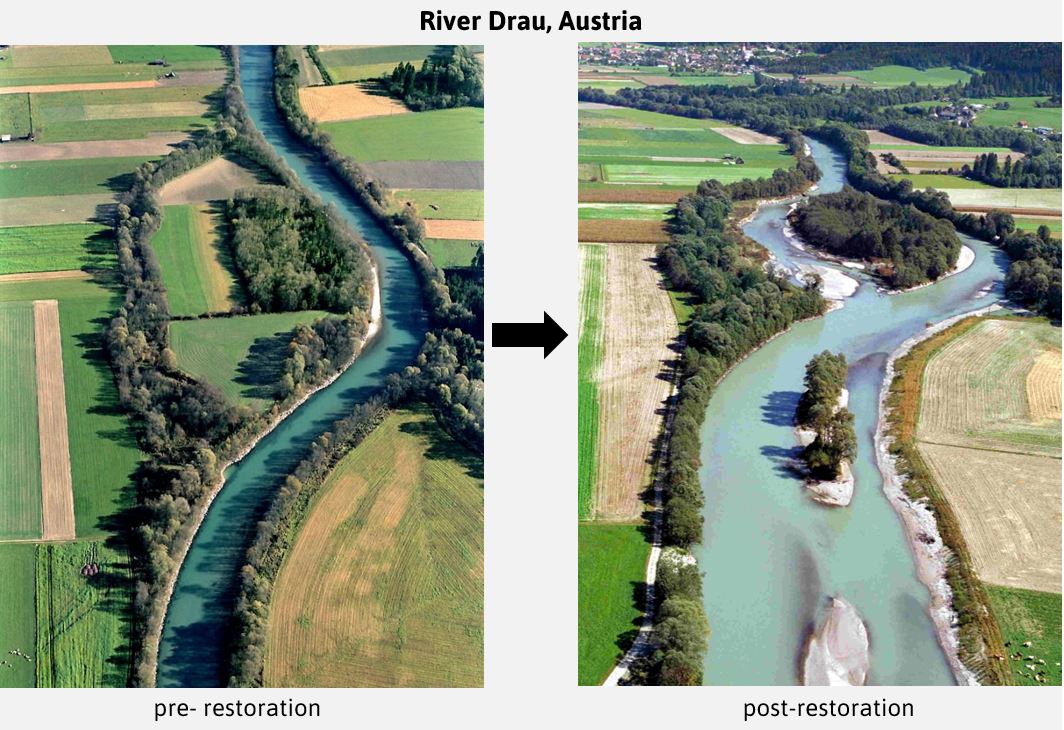
While the US was arguably more active in river restoration in the 1980s, most of the projects now undertaken in the US are still form-based attempts to create idealized features. In many cases, these artificial constructions are not sustained by current, altered river processes. In the EU, by contrast, many projects explicitly aim to restore process, even when this means allowing a ‘messy’ river to develop.
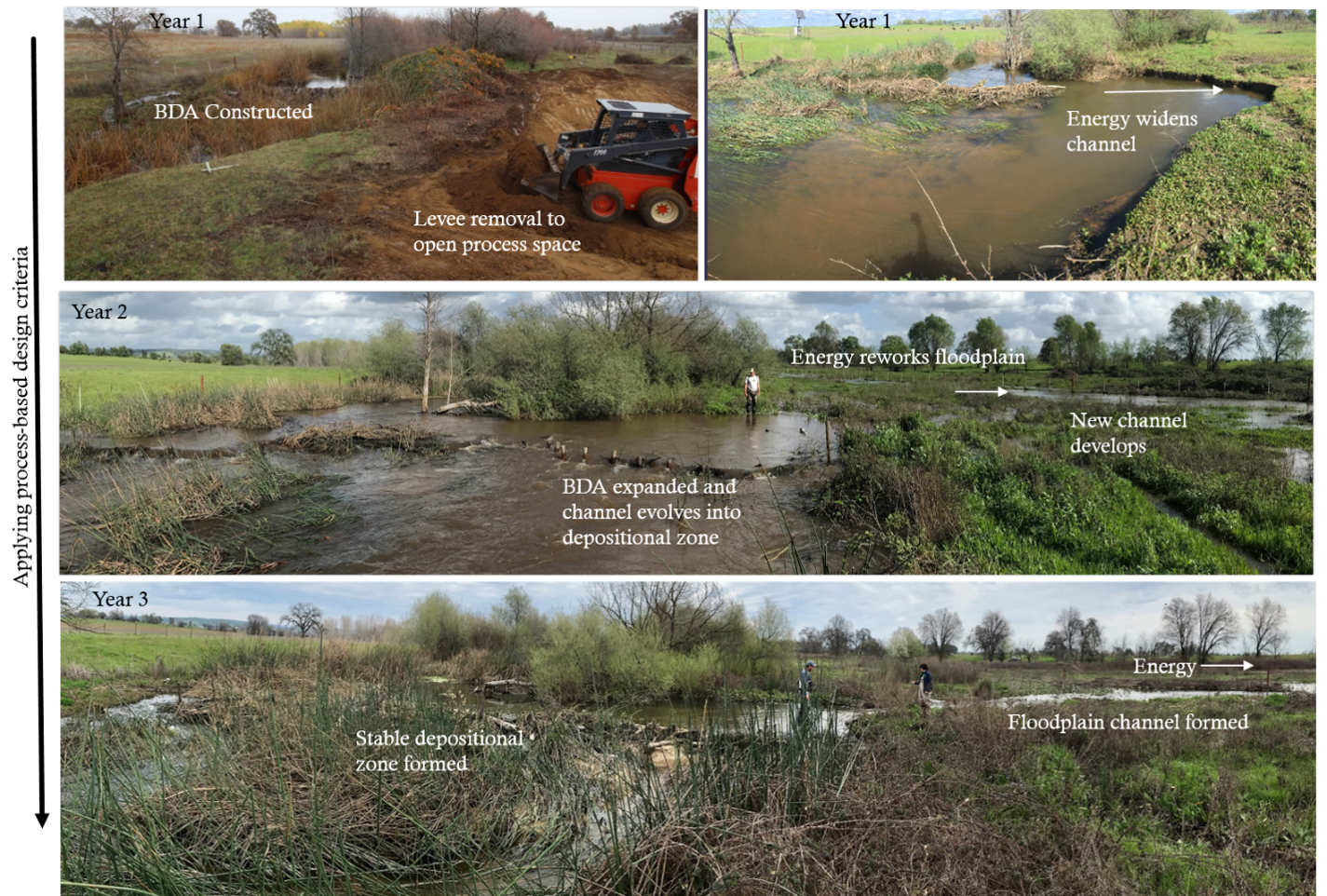
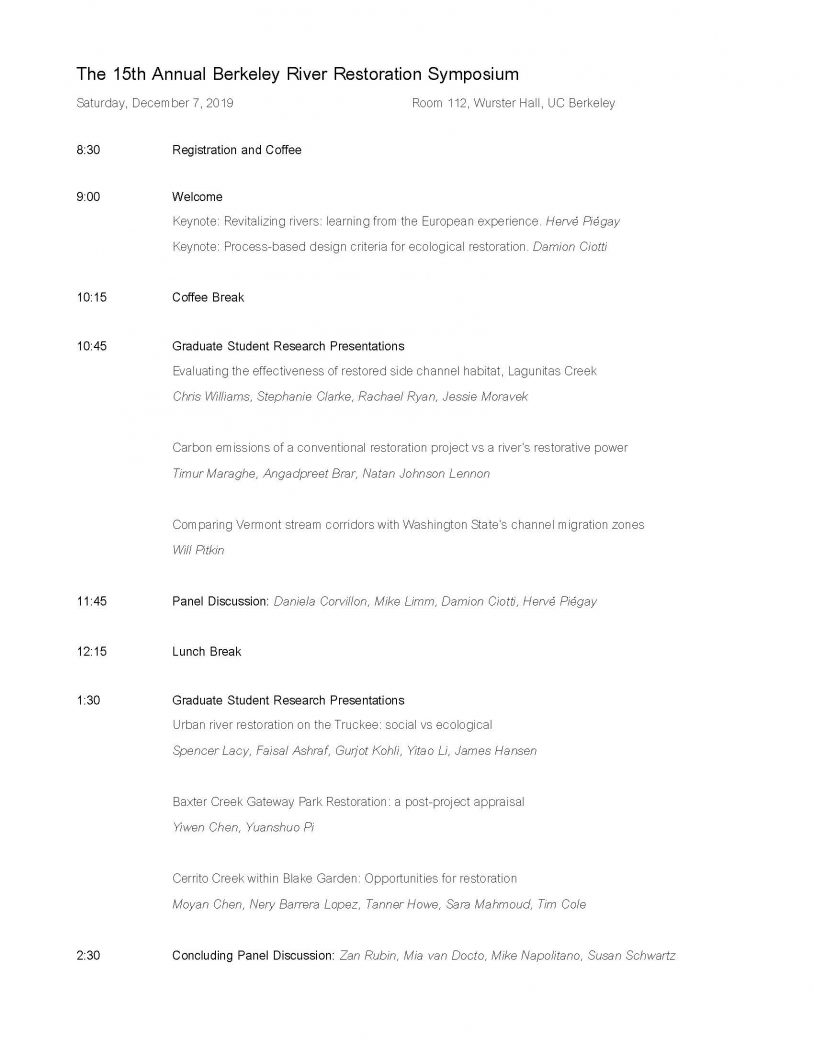
How can we restore true geomorphic and ecological processes in rivers? This question was addressed in the 15th Annual Berkeley River Restoration Symposium (7 December 2019), in keynote talks by Hervé Piégay of CNRS (the French national research agency) and University of Lyon, and Damion Ciotti of the US Fish and Wildlife Service. Piégay’s talk, ‘Revitalizing rivers: learning from a few European case studies,’ summarized some of the key lessons learned from recent restoration efforts in the EU. Despite more projects in the US now claiming to be ‘process based’, real restoration of process is rare. How can we distinguish true process-based restoration projects? Damion Ciotti’s talk, ‘Process-based design criteria for ecological restoration’ presented four distinct attributes of true process-based restoration, along with a detailed illustration of the application of these criteria to a restoration project in the foothills of the Sierra Nevada.
In addition to these keynote talks, graduate students in the River Restoration course presented their independent research projects, including a comparison of a conventional salmon spawning habitat restoration project heavily dependent on external energy sources (diesel fuel) with the energy exerted on the ‘restored’ reach by a natural flood; an evaluation of a side-channel restoration for salmon on Lagunitas Creek; the Vermont and Washington State programs to set aside river corridors; and post-project appraisals of river restoration projects on the Truckee River, Reno, and Cerrito and Baxter Creeks in the San Francisco Bay region. Panels of experienced practitioners and researchers provided perspective on themes arising in the presentations. Click here to see the papers summarizing the graduate student research projects.
The symposium is presented annually by the UC Berkeley Department of Landscape Architecture & Environmental Planning, and the Institute of International Studies Interdisciplinary Faculty Seminar Water Management: Past and Future Adaptation.
Keynote Speaker Bios
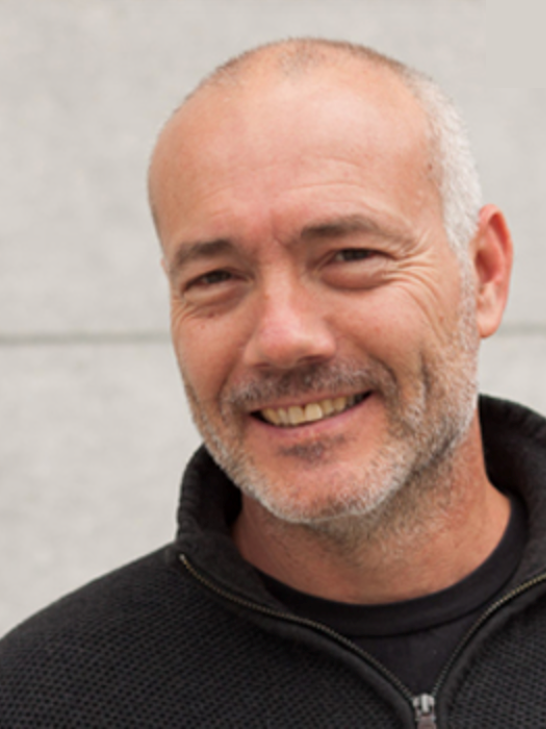
Hervé Piégay is research director at the National Center of Scientific Research, at the laboratory Environnement, Ville, Societe, based at the Ecole Normale Supérieure of Lyon (France). His Ph.D. (1995) documented interactions between riparian vegetation and channel geomorphology. His research is focused on river management, planning and restoration, contemporary history of rivers and their catchments, analyzing human controls on environmental change, floodplain and former channel sedimentation, sediment transport, and budgeting. His work involves integrated sciences, with a strong emphasis on methodological frameworks and innovative tools using tracking techniques, GIS and remote sensing. He frequently works with practitioners to provide insights for river management, planning, and restoration.
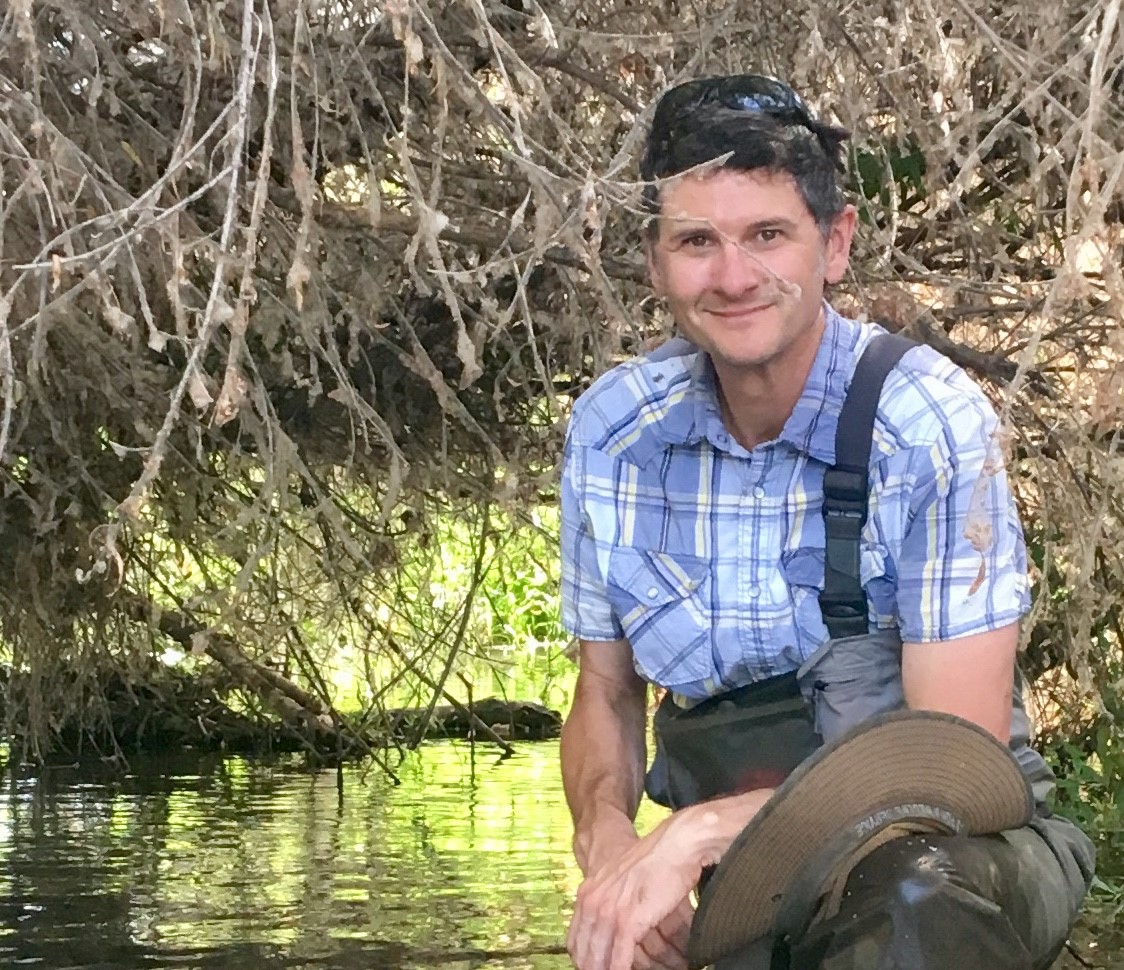
Damion Ciotti is a Restoration Biologist with the US Fish and Wildlife Service in Auburn California. He has over 10 years of experience in design and implementation of stream, river, and wetland restoration in the Sierra, Cascades, Great Basin and Appalachia. Major projects include restoration of stream delta systems in the upper Klamath Basin and stream and floodplain reconnections in the Sierra and Cascades. He is interested in testing applications of ecological science and theory to restoration practice. He also coordinates the Tribal Grants Program for the US Fish and Wildlife Service. Damion has an MS in Environmental Science from Oregon State University and a BS in Soil Science from Penn State and was a Peace Corps volunteer in Paraguay.
About the Class
Restoration of Rivers and Streams (Landscape Architecture and Environmental Planning 227) is taught by Professor Matt Kondolf. Offered annually since 1992, it is the longest-running course devoted to river restoration at a major research university. This graduate-level course emphasizes understanding of underlying goals and assumptions of restoration, and integration of science into restoration planning and design. Students review restoration plans and evaluate completed projects. In addition to lectures and discussions by the instructor, students, and an extraordinary set of guest lecturers drawn from the active restoration community, the principal course requirement is an independent term project involving original research and a presentation at this Symposium.
Building on recent research on the Rhine River between France and Germany, a research team based in Strasbourg has published a review of scientific literature on projects to restore channel complexity downstream of dams. While dam removal has attracted enormous attention in recent years, with notable successes on the Elwha River, the reality is that most dams are here to stay and most river reaches in the developed world are downstream of dams. As these dams capture sediment, they create conditions of sediment deficit in many river reaches downstream. This review found relatively few studies documenting projects to restore sediment supply via gravel augmentation and fewer still via restoration of channel erosion processes below dams (mostly examples from northern Europe). Biological monitoring shows benefits from these projects, whose increasing popularity reflects growing interest in restoration of fluvial process, and an evolving perspective towards adaptive or coupling management approaches to promote the recovery of natural processes in rivers below many dams and thus to improve ecological response.
The paper, Restoring fluvial forms and processes by gravel augmentation or bank erosion below dams: A systematic review of ecological responses, by Cybil Staentzel et al. is available for free download here until 01 February 2020.
The Mattole Restoration Council is a 36 year-old watershed restoration non-profit on the Lost Coast of Northern California, with a million dollar plus annual budget and a regular staff of nine. We are a membership organization with an elected board of directors that undertakes landscape-scale watershed restoration and rehabilitation in the Mattole watershed and adjacent areas, and promotes a stewardship land ethic. For more information about our programs, please visit www.mattole.org.
Job responsibilities
Works with the board of directors to execute the mission and long-term strategic goals;
Oversees and manages 9 regular staff and 60 seasonal employees;
Leads fundraising efforts and works with the program staff to develop projects and submit grant proposals to various federal and state agencies and foundations;
Directs the implementation of organizational policies and the strategic plan;
Acts as liaison to the community, partner groups, agencies, and other stakeholders;
Oversees fiscal management.
Desired Qualifications
Excellent communication skills;
Experience with fundraising and developing federal and state grant proposals;
Experience with managing federal and state contracts;
Ability to establish dynamic relationships with a broad base of stakeholders;
Experience with non-profit fiscal and personnel management;
Commitment to community based watershed restoration;
A background in environmental science/biology/ecology;
Familiarity with watershed restoration strategies and methods;
Strong sense of self-direction and self-organization;
The position is full to half time (negotiable), and reports to the board of directors. Compensation is commensurate with experience, and includes health, vacation, training and retirement benefits. The position is based in the Petrolia office, with travel throughout the watershed and Northern California. A valid driver’s license and functioning personal vehicle are required.
To Apply:Email cover letter, resume/CV and three references to John Williams, [email protected]. For more information, call John at 707 629 3265.
This position is open until filled; interviews begin on January 13, 2020.
In June 2019, Reservoir Sediment Management: Building a Legacy of Sustainable Water Storage Reservoirs was released by the National Reservoir Sedimentation and Sustainability Team (NRSST), a consortium of engineers and scientists from federal agencies, consulting firms and universities, including UC-Berkeley’s RiverLab, studying the impacts of sediment on the nation’s water supply.
This paper outlines the origins and legacy of reservoir sedimentation, where sediment being transported by a river begins collecting behind a dam. While sediment transport is of great benefit to riverine ecologies, the trapping of sediment means decreased water storage capacity in dams, greater flood risk, and reduction in hydropower functions.
Additionally, the paper proposes the following management strategies for mitigating further sedimentation and dealing with existing sediment:
Reduce sediment yield entering the reservoir by trapping more upstream;
Move sediments away or through reservoirs;
Flush or dredge existing sediment deposits;
Adapt to and plan for reduced storage volume in the future. (Randle, 2019)
Tim Randle of the NRSST and Manager of the Sedimentation and River Hydraulics Group at the Bureau of Reclamation was featured in H2O Radio’s recent story “Damned from the Start” discussing the reservoir sedimentation as it applies to the flooding of the Niobara River behind the Gavins Point Dam in Nebraska.
How can we restore true geomorphic and ecological processes in rivers? You are invited to the 15th Annual Berkeley River Restoration Symposium, Saturday 7 December 2019, when these questions will be addressed by keynote speakers Hervé Piégay and Damion Ciotti.
Keynote Presentations
While the US was arguably more active in river restoration in the 1980s, most of the projects now undertaken in the US are still form-based attempts to create idealized features, which may not be sustained by current, altered river processes. In the EU, by contrast, many projects explicitly aim to restore process, even when this means allowing a ‘messy’ river to develop. Piégay’s talk, ‘Revitalizing rivers: learning from the European experience?’ summarizes some of the key lessons learned from recent restoration efforts in the EU.
Despite more projects now claiming to be process based, real restoration of process is rare. How can we distinguish true process-based restoration projects? Damion Ciotti’s talk, ‘Process-based design criteria for ecological restoration’ presents four distinct attributes of true process-based restoration, along with a detailed illustration of the application of these criteria to a restoration project in the foothills of the Sierra Nevada
Keynote Speakers
Hervé Piégay is research director at the National Center of Scientific Research, at the laboratory Environnement, Ville, Societe, based at the Ecole Normale Supérieure of Lyon (France). His PhD (1995) documented interactions between riparian vegetation and channel geomorphology. His research is focused on river management, planning and restoration, contemporary history of rivers and their catchments, analyzing human controls on environmental change, floodplain and former channel sedimentation, sediment transport and budgeting. His work involves integrated sciences, with a strong emphasis on methodological frameworks and innovative tools using tracking techniques, GIS and remote sensing. He frequently works with practitioners to provide insights for river management, planning and restoration.
Damion Ciotti is a Restoration Biologist with the US Fish and Wildlife Service in Auburn California. He has over 10 years of experience in design and implementation of stream, river, and wetland restoration in the Sierra, Cascades, Great Basin and Appalachia. Major projects include restoration of stream delta systems in the upper Klamath Basin and stream and floodplain reconnections in the Sierra and Cascades. He is interested in testing applications of ecological science and theory to restoration practice. He also coordinates the Tribal Grants Program for the US Fish and Wildlife Service. Damion has an MS in Environmental Science from Oregon State University and a BS in Soil Science from Penn State and was a Peace Corps volunteer in Paraguay.
Panelists
Daniela Corvillon is an environmental planner and UC Berkeley grad focusing on design and restoration of natural ecological functions at the interface of human and wild space. At John Northmore Roberts & Associates (Berkeley), she plans, designs, & manages various-scale projects that integrate human uses into natural areas, and restore natural functions on urban environment, working with the National Park Service, NGOs, cities, and private clients. Daniela continues to develop and promote integrated solutions to environmental and social problems in marginal high-need areas of Chile and Cuba, including a wastewater wetland and river restoration project in Palma Soriano, Cuba.
Mia von Docto works as a Conservation Hydrologist for Trout Unlimited. Her work focuses on coastal hydrology, ecological flow thresholds, conservation planning, coho salmon and steelhead trout recovery and translating findings into recovery prioritization actions and regional polices. She specializes in using a combination of field-based data, numerical modeling and geospatial tools to characterize hydrologic process, land-use and human water needs.
Mike Limm is a Professor of Biological Science at Holy Names University. He received his Ph.D. from UC Berkeley in aquatic ecology. His research focuses on hydrologic and hydraulic controls of food webs, carbon and nutrient pathways, and the influence of food web composition on ecosystem processes, conducting research in environments including the northern California Coast Range and Sierra Nevada.
Mike Napolitano is an engineering geologist with the San Francisco Bay Regional Water Quality Control Board. He has been instrumental in supporting and guiding restoration efforts along the Napa River and its tributaries.
Zan Rubin is a Senior Geomorphologist at Balance Hydrologics in Berkeley where he studies of sediment transport, water quality, channel evolution, and restoration effectiveness. He designs stream and wetland restoration projects, with several active projects on planning resilient infrastructure-river crossings. He received his Ph.D. in 2015 with Professor Kondolf with several research projects including the cumulative impacts of hydropower development in the Mekong basin and evaluating the effectiveness of riparian restoration along the lower Colorado River.
Susan Schwartz graduated from UC Berkeley in 1965. She was a newspaper reporter and editor in Fairbanks (AK), Seattle, Akron, and Miami, taught science writing, and wrote three minor guides on natural history before returning to Berkeley to raise a family. She became involved with Friends of Five Creeks and has co-headed or headed the all-volunteer group for 20 years. Friends of Five Creeks works with urban nature in many ways, including a lecture series, walks, other events, publications, interpretive signs, mapping and monitoring, and seeking to influence government. Most of its effort is hands-on, generally in areas neglected or abandoned by public agencies, including after previous “restorations.”
Graduate Student Presentations
Graduate student research presentations include a comparison of a conventional river restoration project heavily dependent on external energy sources (diesel fuel) with the energy exerted on the ‘restored’ reach by a natural flood; evaluation of a side-channel restoration for salmon on Lagunitas Creek; the Vermont and Washington State programs to set aside river corridors; and post-project appraisals of river restoration projects on the Truckee River, Reno, and Cerrito and Baxter Creeks in the San Francisco Bay region. A panel of experienced practitioners and researchers provides perspective on themes arising in the presentations.
Schedule
This symposium is open to the public without charge. Please pre-register here. The symposium is sponsored by the UC Berkeley Department of Landscape Architecture & Environmental Planning, and the Institute of International Studies Interdisciplinary Faculty Seminar Water Management: Past and Future Adaptation.
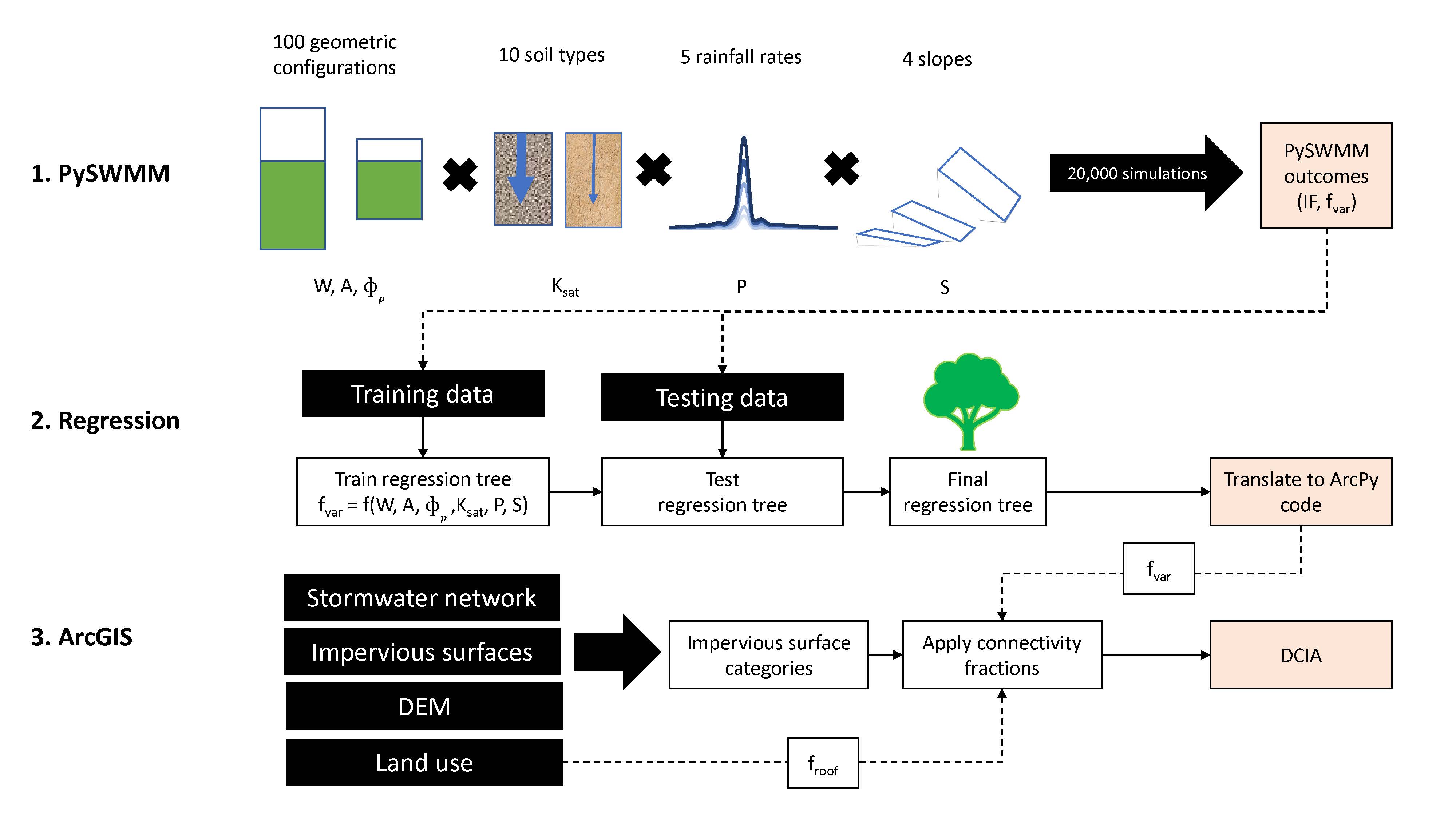
For the past year, RiverLab’s Anneliese Sytsma has been working with Engineering Research Center ReNUWIt – Re-inventing the Nation’s Urban Water Infrastructure – on her PhD dissertation research. This month, ReNUWIt highlighted her research on ‘connected impervious surfaces’ on the ReNUWIt website- see here. Anneliese is working on the manuscript now and hopes to publish before the end of the year.
Accurate methods to predict impervious surface connectivity are needed to improve hydrologic modeling and efficient siting of distributed stormwater technologies. ReNUWIt researchers are developing a new method for estimating impervious surface connectivity across different soil types, slopes, rainfall scenarios and landcover parameters. The outcomes of this research may be used as hydrologic model inputs and to inform more efficient distributed stormwater control siting across heterogeneous urban landscapes.
The San Francisco Bay Regional Water Quality Control Board has an opening for an Environmental Scientist in the Watershed Management Division. The position is located at 1515 Clay Street, Suite 1400, Oakland, CA 94612. The position will play a key role in the Region’s municipal stormwater program team, coordinating implementation of the statewide small and non-traditional municipal urban stormwater permit, and will permit of creek and wetland fill projects, including projects in the Bay margin, among key tasks.
Stillwater Sciences seeks a highly motivated, mid-level environmental scientist/project manager based in Davis, CA to serve as a member of an inter-disciplinary team working on fisheries, aquatic ecology, habitat restoration, water quality, and water resources management projects throughout California.